
Welcome to the Postal Customs Hub
This page is designed for Royal Mail account holders and provides an overview of the key customs information you’ll need when sending items internationally.

If using one of our Consumer services please see here.
Please note that customs rules and regulations differ by country, and Royal Mail does not set or influence these requirements. The guidance provided here is intended as general information only. Export requirements can vary depending on both the type of goods being sent and the specific regulations of the destination country.
The following guidelines apply to these products:
- International Business Tracked
- International Business Tracked Heavier
- International Standard
What do you need to provide when sending using our international services?
- Product label
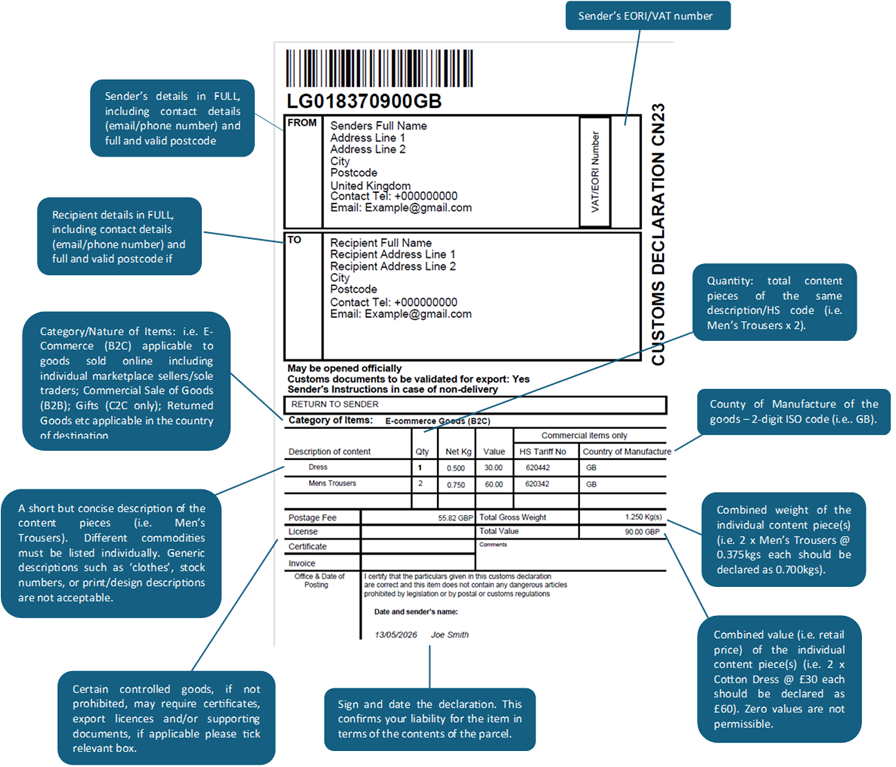
- A fully complete and accurate customs declaration (CN23)
- Any additional licences and certificates if required for your items (please see export licences / regulatory controls section below)
For more information, please visit the ‘What information do I need to provide?’ tab below.
Our Royal Mail shipping solutions will automatically produce all the required documentation* based on the information you provide to us. Please ensure that you supply these documents with your item(s) to avoid any delays or returns.
*Please note: It is your responsibility to identify if any additional licences and/or certificates are required for your items prior to sending. These will not be produced automatically by Royal Mail shipping solutions.
More exporting and customs support
A customs declaration is required for all items containing goods going from the UK to overseas destinations. As the sender, you’re responsible for ensuring the declaration is full and accurate, as you are legally liable for the contents.
Customs authorities rely on this information to check that items meet national regulations and to determine any taxes or duties that may apply. If the declaration is incomplete or inaccurate, your parcel may be delayed, held, or returned by customs - resulting in longer delivery times.
The CN23 is the standard postal customs declaration used internationally to capture essential details about the contents of a parcel to support postal customs clearance processes in both the UK and overseas destinations.
Each destination sets its own import controls and restrictions. Customers should always check whether the items they’re sending require any licences, certificates, or may incur additional charges upon import. For detailed, country specific requirements, please visit our individual country pages.
*Please note: When sending items from Northern Ireland to the EU, customs declarations are not required when sending gifts or goods. Our shipping systems may still prompt for this data and generate a CN23, but it should not be applied to the parcel.
Where required, alongside the CN23 documentation, supporting documents such as commercial invoices, certificates, and licences must be physically supplied when sending your item. These documents should be placed in a clear plastic wallet securely affixed to the outside of the parcel, ensuring all information is fully legible.
We recommend attaching the wallet on the same side as the address label wherever possible. If space is limited, it may be placed on the reverse of the parcel, provided it remains clearly visible and securely affixed.
Missing, invalid, or incomplete documentation can result in your item being delayed, held by customs, or returned to the sender. All supporting documents must be completed accurately before your items are presented to Royal Mail.
As the sender, you are responsible for ensuring that all information provided for customs purposes is true, complete, and accurate. Royal Mail cannot be held liable for incorrect or misleading declarations. We strongly advise familiarising yourself with the relevant export and import customs regulations before shipping.
Electronic customs data is mandatory for all international parcels. Any parcel with missing, incorrect, or incomplete electronic data may be delayed, held by customs, or returned to the sender.
Pre-Registration schemes such as the Import One Stop Shop (IOSS) may require additional data.
International account holders can enter all the required customs information directly through Click & Drop®. These systems will automatically generate the appropriate documentation, such as CN23 forms based on the data you provide.
It is essential that the information submitted is a true and accurate reflection of the items being dispatched, as this data forms part of the electronic customs data used by overseas customs authorities. Royal Mail cannot be held liable for any inaccuracies; the sender is legally responsible for ensuring all customs information is complete, compliant and accurately reflects the contents of the parcel.
We strongly recommend familiarising yourself with relevant export and import customs regulations to ensure items can be processed and cleared without delay.
| Products | Data needed | Documents |
|---|---|---|
|
International Business Tracked International Business Tracked Heavier International Standard |
Sender’s details in FULL, including contact details Ensure the sender’s full name, address, and a valid postcode are included. We also recommend providing contact details, such as a mobile phone number and/or email address . This helps ensure you can be reached if customs or delivery partners need further information about the item. Recipient’s details in FULL, including contact details. Overseas customs authorities require accurate recipient contact information. Providing local recipient contact details such as a mobile number or email address helps ensure the recipient can be reached promptly if additional information is needed. Failure to include this information increases the risk of customs delays, which may impact delivery times. Sender’s GB EORI number / IOSS number (where applicable) EORI numbers should start with 'GB' followed by 12 digits (14 characters in total). IOSS numbers should always begin with 2 alpha (always "IM") characters followed by 10 numeric characters with no spaces. Where this is provided incorrectly, the package is likely to be returned or delayed. Reason for shipment (category/nature of goods) For example, sales of goods, returned goods, commercial samples. Please note: gift is not applicable as a description / nature of goods for commercial items. Content description This must be a concise and accurate description without unnecessary detail (e.g. children’s t-shirt / board game / chocolate bar). For more clarity, please refer to the links below: WCO guidelines on acceptable descriptions Please note: ambiguous or generic descriptions are not allowed. Customs use the content description to facilitate border checks and apply the correct duty rates. The HS/tariff code (minimum 6 digits) HS (Harmonised System) codes or tariff codes are an internationally recognised standard used to identify goods consistently across global customs systems. Because these codes are universally adopted, customs authorities worldwide can understand the type of goods being shipped, regardless of language barriers. This helps streamline customs processing and reduce delays. While the first six digits of an HS code are standardised globally, any digits beyond this are national extensions. Customers must ensure they verify the correct tariff code for the destination country, as requirements can vary. For more information on finding the correct HS/tariff code, please click here. Please note: Royal Mail cannot be held liable for the HS code selected. Value of each individual item in the parcel Please do not combine the value of the parcel if the contents are not the same. When sending a parcel containing a mixture of goods, each item must be listed separately. Every product requires its own line entry with complete and accurate details. Identical items may be grouped on a single line, but you must include the quantity and the value per item. The item value refers to the customs value of the goods only and must not include postage or shipping costs. Items cannot be declared as having zero value, regardless of the reason for sending them. This rule applies to gifts, samples, returns, repairs, and all other item types. For guidance on how to correctly value goods for customs purposes, please click here. Weight per individual item in the parcel Accurate weights are required for each line item in the parcel to ensure that the customs duty and taxes can be calculated where applicable to weight-based calculations. Country of origin This means the country where the goods originated e.g. were produced, manufactured, or assembled. Postage Senders should declare a reasonable and justifiable postage cost amount, relevant to the true costs associated with the transport of the shipment, not a nominal or arbitrary figure (e.g. £0 or £0.01). Sender’s signature This confirms your liability for the item in terms of the contents of the parcel. |
CN23 Documentation required will vary dependent upon method of purchase. |
Certain goods exported to specific countries may require an export licence or additional documentation often issued by relevant regulatory bodies. Where a licence or certificate is required, it must be physically attached to the outside of the parcel in a clearly marked envelope.
Before shipping, please check with the appropriate government department to confirm whether your goods require any additional licences or certificates. The following resource may be helpful when determining export requirements:
For parcels sent to destinations outside of the UK, the thresholds at which taxes and duties become payable vary by country and are determined by the local customs authorities. We strongly recommend checking the threshold applicable to the destination you are sending to.
Customers should also refer to the destination country’s official customs authority website to ensure they have the most accurate and up to date information on thresholds, import restrictions, and any additional requirements.
For customers sending items from Northern Ireland to the EU, a customs declaration is not required. As NI remains aligned with the EU Customs Union, customs taxes and duties do not apply. Where duties are applicable for other international destinations, they are typically calculated based on the contents, value, and weight of the parcel.
Please note from the 1st July 2026 a flat customs duty of €3 will apply per line item to all Business-to-Consumer (B2C) parcels valued under €150 entering the EU. This is non refundable and applies to all eligible goods. Please visit our EU Insights Page for more information.
Additional information
Please note from the 1st July 2026 a flat customs duty of €3 now applies per line item to all Business-to-Consumer (B2C) parcels valued under €150 entering the EU. This is non refundable and applies to all eligible goods.
From 1 November 2026, the EU are introducing an additional handling fee as part of the wider Customs Reform programme. This change will coincide with the mandation of Product Identifier (PID) requirements for applicable shipments. The purpose of the fee is to support the increased customs controls and processing associated with low-value e-commerce imports, while helping customs authorities identify unsafe, non-compliant, or prohibited goods more effectively. The fee has been published in the delegated act as €2 per line, will apply to distance sales and will be charged in addition to the existing €3 customs duty. Please visit our EU Insights Page for more information.
There are a range of organisations in the UK who can help you with all the above. As a starting point and for additional information about exporting goods from the UK please visit the HM Revenue & Customs website.
To check your item is not prohibited or restricted, please click here.
For UPU or country-specific prohibitions and restrictions, please click here.
For additional help with customs and compliance, please click here.